Paid on Paper: The Real Economics of Pharmacogenomic Claims

Analysis · Pinnacle Services Corporation · October 2026. Figures come from pharmacogenomic claims billed by Recovr's laboratory and revenue-cycle customers between June 2023 and October 2026; see the notes on method at the end.
Pharmacogenomic testing has a better clinical pedigree than most tests laboratories struggle to get paid for. The Clinical Pharmacogenetics Implementation Consortium (CPIC) publishes gene–drug guidelines, the FDA prints genotype guidance on drug labels, and most Medicare administrative contractors have written coverage policies. Even so, when we examined every PGx line billed by Recovr's laboratory and revenue-cycle customers between mid-2023 and October 2026, only about half were paid.
The multi-gene panel, CPT 81418, was paid on 62% of lines. Single-gene tests did worse, at 42%. Weighted to the same billing books, other molecular codes were paid 72% of the time. The shortfall is not a referendum on whether PGx works. In the denials we can see line by line, payers rarely disputed medical necessity. Most of the money stalled on authorization and documentation, and those two categories are, historically, among the most recoverable denials in our customers' books.
The rulebook: covered by Medicare, conditionally
Medicare's position is the most permissive in the market and also the most procedural. The MolDX Pharmacogenomics Testing LCD (L38294 at Palmetto GBA, with matching policies at Noridian, CGS and WPS) covers a test when a drug under consideration has a gene–drug interaction that is clinically actionable under FDA labeling or CPIC level A or B. The policy states that testing "is not considered reasonable and necessary merely on the basis of a patient having a particular diagnosis." A multi-gene panel qualifies only when more than one gene on it is reasonable and necessary; a panel justified by a single gene is not covered, and combinatorial tests built on proprietary algorithms are not covered at all. The companion billing article, A58318, revised in July 2026, requires a DEX Z-code beside the CPT code, the names of the drugs under consideration on the claim line, and no more than one test per date of service.
Outside MolDX, the Novitas and First Coast LCDs (L39063 and L39073) apply the same actionability test, cover only the actionable components of a panel, and allow germline testing once in a lifetime per beneficiary.
Commercial payers have largely left the panel market. UnitedHealthcare's commercial policy, effective October 1, 2026, calls pharmacogenetic panels of five or more genes "unproven and not medically necessary for any indication," a position it first adopted in January 2025. Aetna treats multi-gene panels as experimental. Cigna lists 81418 as not covered or reimbursable. Elevance's Carelon guideline deems panel testing for metabolizer status not medically necessary. Humana's commercial policy treats 81418 as experimental, while its Medicare Advantage prior-authorization list names 81418 and four single-gene codes individually.
Payer | Multi-gene panel (81418) | Single-gene tests | Administrative gate |
|---|---|---|---|
Medicare, MolDX contractors | Covered when more than one gene is indicated for a drug under consideration | Covered with FDA or CPIC A/B actionability | DEX Z-code; drug names on the claim line; one test per date of service |
Medicare, Novitas and First Coast | Only actionable components covered | CPIC A/B or FDA labeling | Germline testing once per lifetime |
UnitedHealthcare, commercial | Unproven for any indication (five or more genes) | Policy-specific | Genetic and molecular prior-authorization program |
UnitedHealthcare, Medicare Advantage | Follows the LCDs | CPIC A/B or FDA labeling | Per plan |
Aetna | Experimental and investigational | Covered for named pairs, such as CYP2C19 with clopidogrel and DPYD with fluoropyrimidines; CYP2C9/VKORC1 and UGT1A1 investigational | None stated |
Cigna | Not covered or reimbursable | Covered only with outcome evidence or an FDA label requirement | None stated |
Elevance (Carelon) | Not medically necessary | Once per lifetime per gene | Carelon review |
Humana, Medicare Advantage | Prior authorization required | 81225, 81226, 81227 and 81231 require prior authorization | Prior-authorization list |
The practical consequence is that the panel's payable market is concentrated in Medicare and Medicare Advantage, and in that market coverage turns on paperwork: the drug, the gene–drug evidence, the Z-code, and, for many Medicare Advantage plans, an authorization on file.
What the claims show
Across Recovr's customers, the 244 panel lines were paid at 62% and the 231 single-gene lines at 42%. The 20-point gap is statistically significant (chi-square, p < 0.001). It also matches the only peer-reviewed reimbursement study of its kind we know of: at UF Health between 2019 and 2021, multi-gene panels were reimbursed on 74% of claims and single-gene tests on 43%.
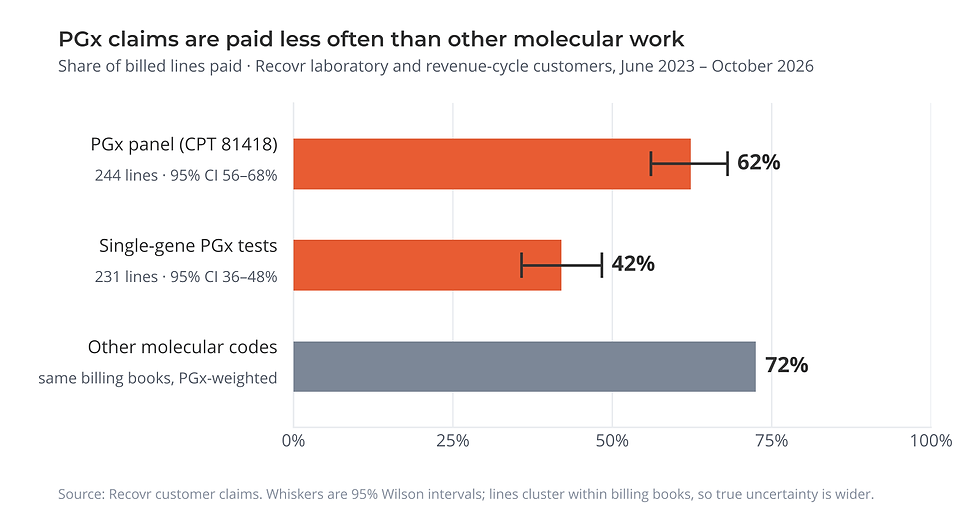
The panel outperforms single genes even though most commercial plans no longer cover panels. One plausible explanation is payer mix: the panel is billed overwhelmingly into Medicare and Medicare Advantage, where MolDX covers it, while single-gene tests are scattered across commercial policies that cover a short list of gene–drug pairs. Our data cannot confirm this for paid lines, so treat it as a hypothesis.
Both PGx categories trail the rest of the molecular book. Weighted to the billing books that bill PGx, other molecular codes were paid on 72% of lines. The gap is not uniform. In one billing book the panel was paid on 74% of lines, above that book's other molecular work, while in another it was paid on 56% against 95% for everything else. The panel rate itself varied from 56% to 74% between billing books, a reminder that payer mix and documentation practice matter as much as the code.
The gene-level story that does not hold up
Single-gene CYP tests (CYP2C19, CYP2D6, CYP2C9, CYP3A5 and SLCO1B1) were paid on 59% of lines, while genes tested before chemotherapy or thiopurines (DPYD, TPMT, UGT1A1 and NUDT15) were paid on 24%. But 74 of those 98 oncology-gene lines came from a single billing book in 2023. Excluding it, the oncology genes were paid on 13 of 24 lines, or 54%. The difference is a billing-book effect, not a gene effect, and we report it to show how easily small PGx samples mislead.

Gene | CPT | Lines billed | Paid | 95% CI | 2026 Medicare rate |
|---|---|---|---|---|---|
CYP2C19 | 81225 | 36 | 47% | 32–63% | $291.36 |
CYP2D6 | 81226 | 28 | 61% | 42–76% | $450.91 |
CYP2C9 | 81227 | 22 | 64% | 43–80% | $174.81 |
CYP3A5 | 81231 | 19 | 58% | 36–77% | $174.81 |
SLCO1B1 | 81328 | 15 | 80% | 55–93% | $174.81 |
DPYD | 81232 | 25 | 20% | 9–39% | $174.81 |
TPMT | 81335 | 42 | 33% | 21–48% | $174.81 |
UGT1A1 | 81350 | 27 | 19% | 8–37% | $234.00 |
CYP3A4, NUDT15, VKORC1 | 81230, 81306, 81355 | 17 | 12% | n/a | n/a |
Panel, six or more genes | 81418 | 244 | 62% | 56–68% | $917.08 |
Anatomy of a panel denial
For the subset of claims where we hold line-level remittance detail, 87 adjustment lines were posted against 81418 between late March and early October 2026. Thirty-one of them were CARC 253, the 2% Medicare sequestration reduction applied to paid lines. That is not a denial, and we excluded it. The remaining 56 denials fall into five groups.

Denial group | Codes | Lines | Share |
|---|---|---|---|
Authorization | CARC 39, 197, 243 | 23 | 41% |
Documentation and information | CARC 252 (with M127, N4), 226, 16 | 22 | 39% |
Medical necessity | CARC 50 | 5 | 9% |
Network | CARC 242 | 3 | 5% |
Other | CARC B9, 193, 279 | 3 | 5% |
Two features stand out. Medical necessity is a sideshow. Medical-necessity denials, the category most people imagine when they think of PGx, account for fewer than one in ten. Payers are not mainly arguing about whether the test is warranted; they are asking for an authorization or a record. The denials are concentrated in Medicare Advantage. Those plans produced 35 of the 56 panel denials, commercial plans 11, and Medicaid and exchange plans 10. The largest single cause was Humana, CARC 39, "services denied at the time authorization/pre-certification was requested," on 20 lines. That is consistent with Humana's published Medicare Advantage prior-authorization list, which names 81418 individually.
What is recoverable
The denial codes that dominate the panel book are the ones our customers have historically reversed. Across all of Recovr's customers and all procedure codes, roughly 80% of lines denied with CARC 39 were later paid. The figures for CARC 252 with remark M127 (missing medical record) and with N4 (missing prior-payer EOB) are roughly 70% and 80%. By contrast, CARC 197, which means no authorization was requested at all, was later paid only about 10% of the time, and network denials (CARC 242) about 1%. Thirty-six of the 56 panel denials, or 64%, fall in codes with a 70–80% historical recovery rate. Recovr's recoverability scoring currently flags 19 of the 56 as worth pursuing, 18 of them CARC 39 lines.
The distinction between CARC 39 and CARC 197 is the practical one. A denial at the time of the authorization request means there is a file to argue from: a test ordered for a named drug, which can be measured against the gene–drug criteria the plan says it applies. A missing authorization leaves no such file. In the documentation group, the claim simply needs the record the payer asked for.
A resubmission or reconsideration that stands a chance contains the same five elements the rulebook asks for.
Element | What the claim needs | Where the rule comes from |
|---|---|---|
The drug | The drug under consideration named on the claim line (Loop 2400) and in the requisition | MolDX billing article A58318 |
The evidence | A gene–drug pair at CPIC level A or B, or FDA labeling, for each gene billed; for a panel, more than one indicated gene | MolDX LCD L38294; Novitas and First Coast LCDs |
The registration | The DEX Z-code beside the CPT code in MolDX jurisdictions | MolDX billing article A58318 |
The coding | No single-gene codes for the same genes alongside 81418 | NCCI Policy Manual, Chapter 10 |
The history | A check for a prior test; several policies allow germline testing once per lifetime, per beneficiary or per gene | Novitas and First Coast LCDs; Carelon guideline |
Paid is not paid in full
Approval rates flatter the economics. Where we hold remittance dollars, 51 paid panel lines between April and September 2026 brought in an average of $430 in insurance payment, or $459 including amounts applied to patient deductibles. That is about half the 2026 Medicare national limitation amount for 81418, $917.08. The figure blends payer contracts and does not separate partial payments, so read it as an indicator rather than a rate.
The Medicare rate itself is about to move. Section 6226 of the Consolidated Appropriations Act, 2026 removed any reduction for 2026. From January 2027 through 2029, Clinical Laboratory Fee Schedule rates reset to private-payer medians reported between May and July 2026, with annual cuts capped at 15%. Codes whose commercial payments sit well below the current Medicare limit are the ones exposed to that cap.
What it means for laboratories
PGx is payable, but only in a narrow corridor. The panel's market is now Medicare and Medicare Advantage, and in that market a claim is paid when it proves the drug, the gene–drug evidence and, increasingly, the authorization. When it is denied, the reason is usually administrative, and administrative denials are the ones that can still be reversed after adjudication. The laboratories that keep PGx economic will be the ones that treat each denial as a missing document rather than a verdict.
Notes on method
Paid rates are computed on billed lines, not claims or dollars, from monthly CPT-level counts across Recovr's laboratory and revenue-cycle customers; a line counts as paid when the payer remitted a payment on it. The panel is CPT 81418. Single-gene tests are 81225, 81226, 81227, 81230, 81231, 81232, 81306, 81328, 81335, 81350 and 81355. We excluded 81291 (MTHFR, which has no CPIC level A or B guideline), 81381 (HLA class I typing, which is also used for transplant work) and 81479 (unlisted molecular). No PLA-coded PGx tests, such as 0345U, appeared in the data. The molecular benchmark covers all other 81xxx lines in the same billing books and windows, with each book weighted by its PGx volume.
Intervals are 95% Wilson intervals. They understate true uncertainty because lines cluster within billing books, and because the time windows differ: single-gene lines are mostly from 2023 and 2024, panel lines from late 2025 and 2026. The denial analysis uses line-level adjustment detail for 81418 processed between March 25 and October 5, 2026, for the subset of claims where we hold it. Historical recovery rates are the share of denied lines later paid, by denial code, across all Recovr customers and all procedure codes; they are not specific to PGx. Dollar figures cover 51 paid panel lines between April and September 2026.
Sources: CMS, MolDX LCD L38294 and billing article A58318; Novitas LCD L39063 and First Coast LCD L39073; 2026 Clinical Laboratory Fee Schedule and PAMA timeline; NCCI Policy Manual, Chapter 10. UnitedHealthcare, Pharmacogenetic Testing 2026T0587Z and Medicare Advantage policy MMP391.17. Aetna, CPB 0715. Cigna, Coverage Policy 0500. Carelon, Pharmacogenetic Testing guideline. Humana, Medicare Advantage prior-authorization list and pharmacogenomics policy HUM-0531-024. Lemke LK et al., "Reimbursement of pharmacogenetic tests at a tertiary academic medical center in the United States," Frontiers in Pharmacology, 2023. CPT is a registered trademark of the American Medical Association.
Pinnacle Services Corporation builds Recovr, an AI post-adjudication claim-recovery platform for laboratories, physician groups and revenue-cycle companies. The payability analysis above can be reproduced on any laboratory's 835/837 file set.


